Request a quote
We reply by email or WhatsApp.
We only use these details to reply to your inquiry.
Fast answer: A bouncy castle rules sign should tell riders to remove shoes and sharp objects, avoid flips and wrestling, keep 5 feet apart and stay off the walls and doorway. Kentucky requires such a sign at the entrance when the rules are not printed on the unit. Add the unit’s rider limits and a high-wind stop rule.
By CH Inflatable technical team · Last updated: 2026-11-23
Are bounce houses safe? They are when three things are in place every time the blower runs: the unit is staked down as its manual says, a trained attendant watches the whole session, and riders follow a posted rules sign. Are bounce houses dangerous when one of those is missing? The risk rises, and it rises most with wind.
Wind needs the closest watch: for outdoor use the unit must be secured with ground stakes and guy lines, and it should not run in high winds or other bad weather. This page is written for inflatable rental companies, school and church event teams and venue operators who buy commercial bounce house manufacturer stock and need the rules, the numbers and the after-incident steps in one place. The sign wording comes first, then what each unit type adds, then the label checks, the failure points and the questions buyers ask before they order.
Each row below is one number or rule a buyer can check before the first event. Read the source column to see whether it is a state rule or our own product terms.
| Fact | Number or rule | Source |
|---|---|---|
| Entrance rules sign | Required at the entrance when the rules are not printed on the unit | Kentucky 302 KAR 16:121 |
| Spacing between riders | 5 feet from another person | Kentucky 302 KAR 16:121 |
| Commercial use | Only units made for commercial use may be rented out | Kentucky 302 KAR 16:121 |
| Report after a serious injury | Phone the state at once, email an incident report within 24 hours | New Jersey DCA |
| Dry slides over 20 feet | Annual inspection before a state operating permit | Missouri Division of Fire Safety |
| Warranty on our units | 1 year for inflatables, 6 months for air blower | CH Inflatable terms |
| Certificate for our land units | EN 14960 certificate | CH Inflatable certificates |
A bounce house is as safe as its anchoring, its supervision and its rules sign. The unit itself sets the starting point. Netting around the jumping area keeps riders from rolling off the platform when they jump near the edge.
On our bounce houses and slides, safety netting is fitted as standard around the jumping area and on both sides of the slide, and guardrails can be built higher on request.
Before you open a unit to riders, check these points in order:
⚠ Stop the session and get everyone off if the wind picks up. For outdoor use, the unit must be held down with ground stakes and guy lines, and it should not run in high winds or other bad weather.
📐 Keep riders 5 feet apart. Kentucky writes that distance into its entrance rules, and it is the simplest number for an attendant to enforce.
💡 Printing the rules on the unit itself saves carrying a separate stand to every party, and the text cannot blow away. Ask for the sign panel when you send your artwork.

Mesh windows on the side walls let the attendant see into the jumping area from outside, and the netting keeps riders in when they jump near the edge. CH-IB26001 is 4.5 × 4.5 m (14.8 × 14.8 ft) and 4.5 m (14.8 ft) tall, runs on one 1,500 W blower (110–240 V) and uses 0.55 mm / 850D Plato PVC on the main body.

On our bounce house and slide combos, safety netting comes standard around the jumping area and on both sides of the slide, and guardrails can be raised on request. CH-IB145 is 6 × 4.5 m (19.7 × 14.8 ft) and 3.9 m (12.8 ft) tall, with a castle-themed print and turrets that suit birthday party rentals.
The Kentucky entrance list applies to every unit type; each type then adds its own checks. The table pairs each type with the extra line it needs on the sign and the setup point the crew should confirm.
| Unit type | Add to the posted rules | Setup check for the crew |
|---|---|---|
| Bounce house | Rider count and age group from the label; no flips, no wrestling | Stakes or sandbags at every anchor point |
| Dry slide | One rider per lane at a time; wait until the landing is clear | In Missouri, a dry slide over 20 feet needs an annual state inspection |
| Obstacle course | Start one rider per lane; keep younger children in their own session | Entrance and exit both in sight of an attendant |
| Water slide | Shoes off, no running on the wet base; same rider limits as the label | Grass is the best base; lay protective mats on concrete and clear sharp stones from sand |
Who uses these units shapes which rules matter most. A church fair with a wide age range needs the session split more than a single-age birthday party does. Build quality matters too: our land units use 0.55 mm / 850D Plato PVC on the main body, with double-stitched seams and PVC reinforcement strips at high-stress points.
Land units from us ship with a repair kit, ground stakes, sandbags and an operating manual, so the anchoring set is in the box. A standard bounce and slide combo needs 2 people to set up and take down, and larger models need 3. For slide lanes, course layouts and water units, see our pages on commercial inflatable slides, inflatable parks and obstacle courses and commercial water inflatables.

Bounce house rules apply first: post the rider count from the label, here 8–10, with no flips and no wrestling. CH-IB158 is 6.5 × 4 m (21.3 × 13.1 ft) and 2.5 m (8.2 ft) tall, runs wet or dry on one 1,500 W blower, and carries a castle and rainbow-themed print for party rental fleets.

On a dry slide the sign adds one rider per lane at a time and a clear landing before the next start. CH-IS065 is 8 × 4 m (26.2 × 13.1 ft) and 4.3 m (14.1 ft) tall for 8–10 riders, with a safari-themed print of giraffes, elephants and zebras for school fairs and party rentals.

On an obstacle course, start one rider per lane and keep younger children in their own session. CH-OC006 is 9 × 4 m (29.5 × 13.1 ft) and 4.5 m (14.8 ft) tall for 12–15 riders, with a slide at the end and a building blocks-themed print that suits school and church events.
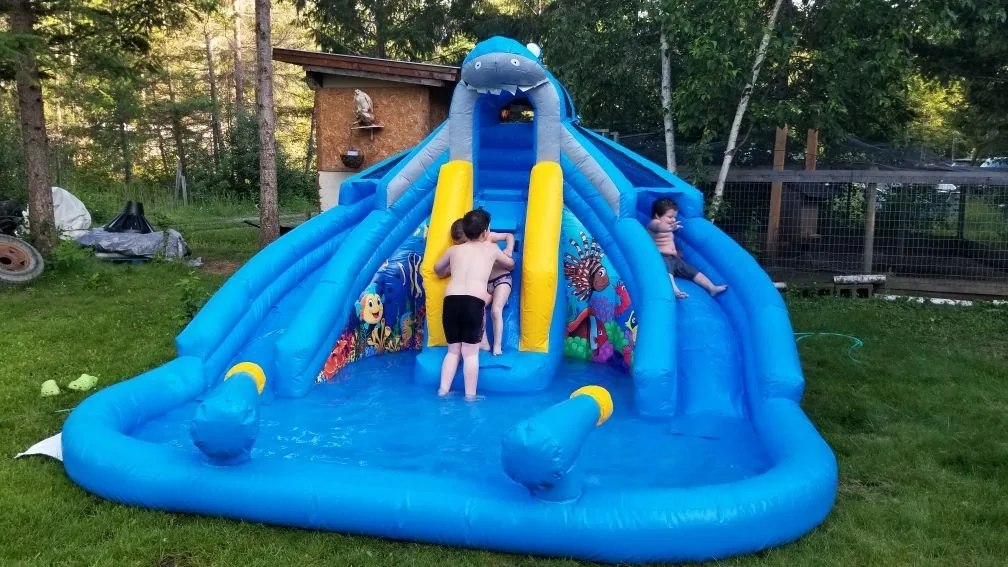
On a water slide the sign adds shoes off and no running on the wet base. CH-WS024 is 7 × 3.8 m (23.0 × 12.5 ft) and 4.2 m (13.8 ft) tall with a splash pool at the foot, in a shark-themed print with sea-life artwork on the slide walls. Grass is the best base for it.
Read the limits on the unit itself. A child’s age is only a rough guide, whereas the label and the operating manual give the maximum rider count and the size of rider the unit was built for (and the sign at the entrance should repeat both). Our standard sizes are for children aged 3 to 12. If you need adult or parent-child sizes, we make those on request, so let us know the target age group before you order.
| What to check | Where to find it | What to do with it |
|---|---|---|
| Maximum riders at one time | Unit label and manual | Write the number on the entrance sign |
| Rider height or age group | Unit label and manual | Split sessions by size, not by ticket |
| Maximum total load | Unit label and manual | Check it with our weight limit check |
| Mixed ages | Your guest list | Keep young children apart from older kids |
| Toddlers | Your guest list | Give them a low, toddler-sized unit with an adult watching |
| Slide height | Unit specification | Check your state’s inspection rule for tall dry slides |
Busy events go more smoothly when the younger children and the older kids get separate sessions. Toddlers need a low unit built for their size, and an adult watching for the whole time they are on it. Slides may also come with a height rule; in Missouri, a dry slide taller than 20 feet must pass an annual safety inspection before the state gives it an operating permit.
Copy the text below onto a board at the entrance, or ask for it to be printed on the unit. Kentucky requires an entrance sign when the rules are not printed on the unit, and its list gives the first seven lines. The last four lines come from the unit label and from your own site plan, so fill in the numbers before the first event.
BOUNCY CASTLE RULES
A bouncy castle safety notice works best at eye level for the riders, next to the entrance where the attendant stands. Keep the wording short and in the language your guests read. A bounce house rules sign and a bouncy castle rules sign carry the same lines; only the name changes between US and UK guests.
No download is needed. Paste the eleven lines into a sign template in any design program, keep the file editable so you can change the limits for each unit, and take it to a print shop.
Pick one high-contrast color pair, such as dark text on a light board, so riders can read the rule sign from the queue. Indoor venues can show the same text on a digital display beside the entrance. For a custom panel printed on the unit, send the final wording with your artwork. If you rent across state lines, check each state’s list, because the required lines are not the same everywhere.

A pictogram rules panel is fixed on the front base, next to where riders climb in, so the rules travel with the unit and no separate stand is needed. The panel shown is printed in the buyer’s language; send your final wording with your artwork. CH-OC006 is 9 × 4 m (29.5 × 13.1 ft) for 12–15 riders.

A safety rules panel sits on the front base beside the entrance, so riders pass it on the way in. CH-IB024 is 4.6 × 4 m (15.1 × 13.1 ft) and 3 m (9.8 ft) tall for 6–8 riders, on one 1,500 W blower, with a Minions-themed print for birthday party rentals; themes can be changed on order.
The five gaps below cause the failures covered on this page, and each one has a simple check before the session starts.
| Problem | What to do | Check |
|---|---|---|
| Wind lifts the unit | Stake every anchor point, tie the guy lines and stop in high winds | Forecast wind against the manual; run our wind and anchoring check |
| A seam opens or the unit loses air | Stop using the unit, get all riders out, turn off the blower, then deflate it | Walk the seams and the blower tube before each session |
| No rules sign | Post the entrance list when the rules are not printed on the unit | Sign is at the entrance and readable |
| No attendant or mixed ages | Keep a watcher on duty for the whole session and split young children from older kids | Name the attendant on the event sheet |
| Wrong equipment | Kentucky allows only units made for commercial use to be rented out | Ask the seller for the material and seam details |
The fifth row is the one buyers can settle before they order. Ask any seller for the PVC thickness, the seam method and where the stress points are reinforced, and compare the answers before you pay.

Each anchor point is a stainless steel D-ring held by webbing and a PVC tab, double-stitched to the base. Walk the base before riders go on: every ring should carry a stake or a guy line on outdoor sites, and the stitching around the tab should be whole.

The blower connects through a fabric tube at the rear and has to run without a break while riders are on the unit. Check that the tube is tied tight and the intake is clear. CH-IB26001 is 4.5 × 4.5 m (14.8 × 14.8 ft) and runs on one 1,500 W blower (110–240 V).
These are short answers to questions buyers ask before a quote; each one points to the page with the full detail.
Yes, a bounce house can run indoors if the ceiling clears the unit height and the blower has a safe power point. Check the unit height on the specification sheet against your venue, leave room above the roof for riders’ raised arms, and see our commercial bounce houses range for sizes. Indoor sites still need the blower intake kept clear of curtains and loose decorations.
Water slides and water parks need their own care: our water units ship with waterproof PVC glue, thick patches in several colors and a valve wrench, and a pressure gauge is optional. Do not fold or store a unit while it is damp, because damp vinyl can grow mold; the cleaning and storage guide covers the full routine.
1 year for inflatables, 6 months for air blower. Cover includes main seam stitching that comes loose, material tears not caused by people and blower motor failure; it excludes cuts and punctures, overloading, storm damage and normal wear.
Our land units hold the EN 14960 certificate, and our water units hold the EN ISO 25649 certificate. What each one covers is on the certificates and test reports page, and PDF copies are sent by email on request.
A typical load is about 68 units in a 40HQ container and about 35 units in a 20GP, confirmed per model. Unit footprints are in the bounce house size guide.
Rules for renting out inflatables differ by state and country. Kentucky, for one, allows only units made for commercial use to be rented. Our page on permits for a rental business lists what to ask your local office.
Stop the ride first, then report. New Jersey gives a clear example: after an ejection, a critical component failure or a serious injury, the owner must shut the ride down, report to the state by phone at once and email an incident report within 24 hours. Other states set their own deadlines, so keep your local office’s number on the event sheet.
Write down the time, the wind reading, the number of riders and the attendant’s name while they are fresh. Note which unit was in use, by model code, and when it was last set up and checked. Photos of the anchor points and any damaged seam help both the report and any warranty claim. The New Jersey incident report guidance shows the fields one state asks for; your own office may ask for more or fewer.
Sometimes the right call is a different unit, or a different activity altogether. Any one of these five situations is reason enough to change the plan before the day.
A low toddler unit might suit the event better than a standard castle. So might an obstacle course with lanes, or simply a later date. And if the date is fixed? Leave the unit packed and have a covered activity ready. Guests then have something to do instead of standing around waiting for the wind to drop.
It should list the entrance rules: remove shoes and sharp objects, no flips, no wrestling, keep 5 feet from other riders, and stay off the side walls and the doorway. Add the rider count and size limits from the unit label, plus a line that everyone gets off in high wind. The printable version above has all eleven lines.
Four hazards are worth checking before every session. Wind and weak anchoring come first: stake the unit as the manual shows and stop in high winds. Missing or ignored rules are second, which is why a rules sign belongs at the entrance.
Mixed ages with no watcher are third; keep young children apart from older kids, under constant supervision. Equipment not built for rental is fourth, so rent out only units made for commercial use. Check all four before you open.
Yes, safety netting comes standard around the trampoline and on both sides of the slide to prevent falls; guardrails can also be raised upon request.
For outdoor use, the item must be secured using ground stakes and guy lines. Do not use it during high winds or other adverse weather conditions to avoid safety risks. Our land units ship with ground stakes and sandbags, so stake every anchor point as the manual shows and check the forecast before each setup.
Shoes come off on every rules list cited on this page; socks are the operator’s call. Grip and hygiene are the two reasons to decide either way, so state your rule on the sign and follow the unit manual.
No. Age is not the limit; the rider count and size limits on the unit label are. Put children of similar size in the same session, and give toddlers a low unit of their own. Adults need a unit rated for adults; check the load with our weight limit check.
Shut the ride down first. Then report the incident as the rules where you operate require; reporting deadlines and formats differ, so check them with your local ride office.
Yes. Keep an attendant on duty for the whole session, with the number of watchers set by the manual and local rules. Young children should not share a session with older kids, and toddlers need constant supervision on a low unit. Before each session the attendant checks the rider count and size limits on the sign.
How this page was written: the CH Inflatable technical team built it from the state rules listed above, plus our own warranty, certificate and shipping terms. The page reports no wind or injury tests of our own, and rules differ by state and country, so check your local office before you open. Last updated: 2026-11-23.
About CH Inflatable: Guangzhou CH Inflatables Co., Ltd., founded in 2009, makes commercial inflatables at No. 400 of Shinan Road, Dongchong Town, Nansha District, Guangzhou, Guangdong, China. Email ch@inflatable.net.cn; we reply within 2 hours. Visit the CH Inflatable home page for the full range.

CH Inflatable is the brand of Guangzhou CH Inflatables Co., Ltd., a commercial inflatable manufacturer founded in 2009 in Nansha District, Guangzhou.
