Request a quote
We reply by email or WhatsApp.
We only use these details to reply to your inquiry.
Fast answer: CH Inflatable land inflatables are designed and verified to EN 14960. Water products are verified to EN ISO 25649. Our PVC tarpaulin is tested to EN 71, the 0.6 mm grade has passed the M2 flame-retardancy test, and the blowers we use are UL-certified.
Each land and water product line is covered by third-party verification, and orders are checked against a five-item factory QC list before packing.
Quality at CH Inflatable is shown with named documents, not adjectives: product-line certificates, material test reports and blower documents. The holder named on the product-line certificates is Guangzhou CH Inflatables Co., Ltd., a manufacturer founded in 2009 with a 4,000 m² factory in Nansha, Guangzhou.
Business owners comparing inflatable manufacturers can ask the same two questions of every supplier.
Company background, staff and markets are on the about CH Inflatable page.
Each certificate and test report is shown below with what it covers. Rental companies and inflatable operators can quote these lines in an insurance or permit file, then attach the PDF copy.

EN 14960 certificate (CE certification)Land inflatables: bounce houses, dry slides, fun cities, obstacle courses and parks

EN ISO 25649 certificateWater products: water slides, water parks and water obstacle courses

EN 71 test reportPlato PVC tarpaulin (the material, not the finished unit)

M2 flame-retardancy test report0.6 mm PVC grade, 610 g/m²

UL certificationThe blowers we use

CE-certified blowersCE certificate for the blowers we use
Each document covers one layer of the product: the finished land unit, the finished water unit, the PVC it is made from, or the blower that keeps it up. Our inflatables and blowers are also CE certified. EN 14960 and EN ISO 25649 are the industry standards named on the product-line certificates, so read the scope before you use a line in a safety standards file. Whichever supplier you choose, ask for the certificate or test report behind a statement before you use it for insurance or a permit. To see which standards apply in your market, try the standards checker.
The EN 14960 certificate covers the land product lines: bounce houses, dry slides, fun cities, obstacle courses and parks. EN 14960 is the European standard for inflatable play equipment.
For water slides, water parks and water obstacle courses, the reference is our EN ISO 25649 certificate. Questions on bounce house safety for a land unit belong to the EN 14960 line above.
The test reports describe the material, not the finished unit. The Plato PVC tarpaulin is tested to EN 71, and the M2 flame-retardancy test applies to the 0.6 mm grade only.
The blowers we use are UL-certified. The UL certification applies to the blower, not to the inflatable itself.
The factory QC list has five items, and an order is checked against all five before it is packed.
The inflation test is the one you can watch: ask for the factory tour and test videos before you order. Warranty terms sit beside the checks: 1 year for inflatables, 6 months for air blower, covering main-seam stitching failure, material tears that are not caused by users, and blower motor faults.
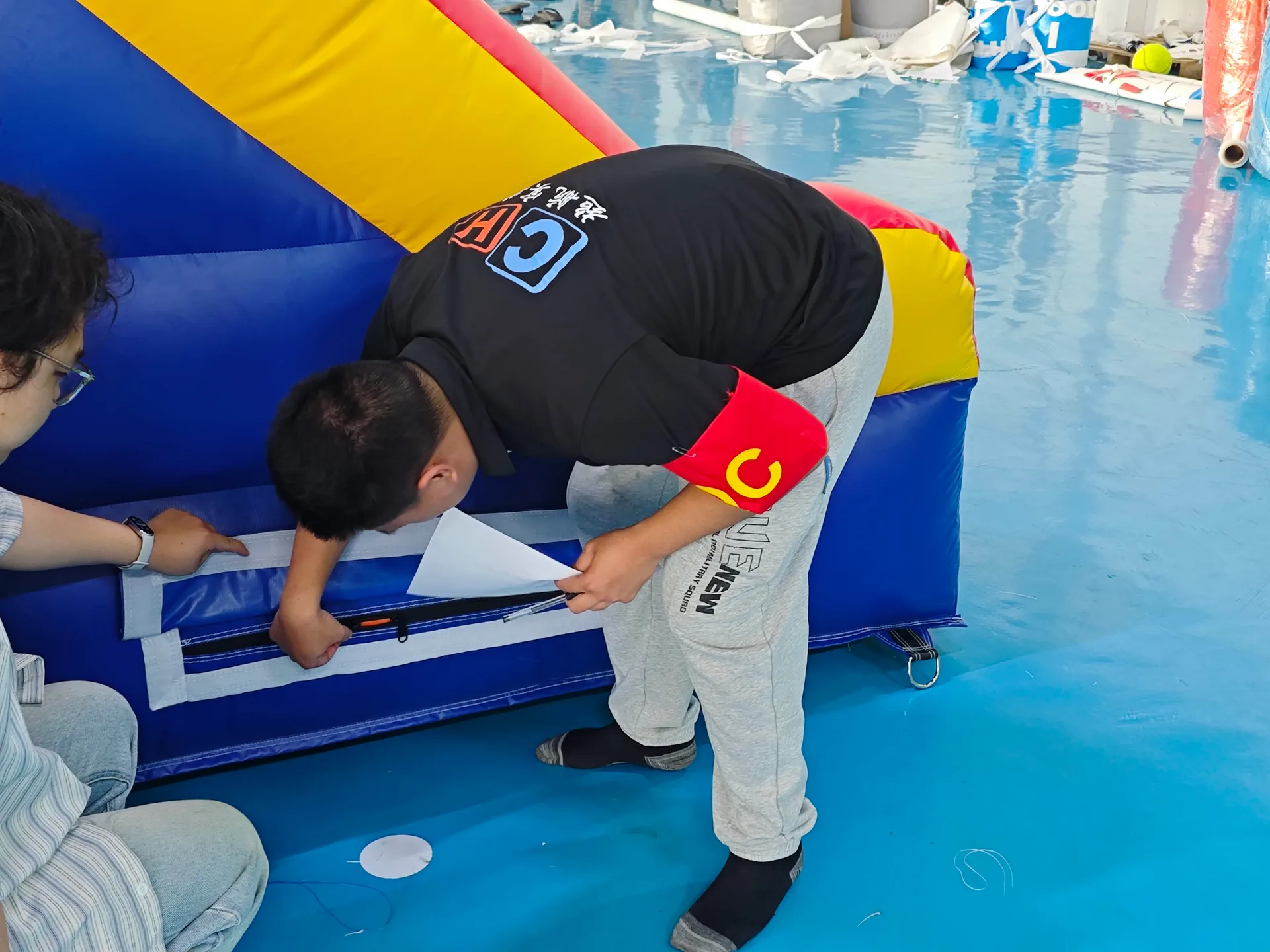
A QC inspector goes along the base seam and the zipper opening of an inflated unit with the checklist in hand. Stitching at zipper openings has to run straight, with both zipper ends reinforced; this sits beside the stitching tensile test on the five-item QC list.

The unit stays inflated while the inspector works around the base and applies the label. Every order goes through the 24 h inflation test and the blower operation check before it is deflated and folded.

The last item on the QC list: the inspector walks around the inflated unit and compares it with the approved drawing, looking at colors, printed panels and seam lines before packing is released.
The production route has seven steps, and each check is listed against the step it relates to.

Production starts from the Plato PVC color fan: the grade and colors are fixed here, and the flame-retardant material test on the QC list applies to this material.

Themes and logos are printed on the PVC before cutting. We use UV printing with a protective film over the print, which guards the artwork against scratches and keeps the image sharp.

After printing, the PVC panels are cut on a computerized automated CNC cutting system before they go to sewing or heat welding.

Land inflatables are sewn with double-stitched seams as standard, and reinforced stitching is available on request. The stitching tensile test follows this step.

Water slides, water parks and water obstacle courses are heat-welded at high temperature: the seam is formed by melting the PVC coating of two overlapping layers together.

After the overall appearance check the unit is deflated, folded and rolled for packing. Land units ship with a repair kit, ground stakes, sandbags and an operating manual.
Four points from the factory’s production standard for land products show what the checks look for.
Protruding thread ends are cut off cleanly after sewing, so seams finish flat.
Seams in the jumping area and along the base of the walls get 0.55 mm PVC reinforcement strips, with the strip edges hidden, not left open.
Stainless steel D-rings are wrapped in black webbing and PVC, both passed through the ring, then double-stitched.
Each hook-and-loop strip is a single 8–10 cm strip, not two narrow strips joined together, fixed with three rows of stitching.
Our water products, including inflatable water slides, water parks and water obstacle courses, are made of 0.6 mm and 0.9 mm Plato PVC, 1300D / 1900D, with heat-welded seams; our land inflatables use double-stitched seams as standard, with reinforced stitching on request. Heat welding melts the PVC coating of two overlapping layers into one seam, and a weld does not puncture the fabric the way needle stitching does. For welded inflatables generally, seam checks include visual inspection for burn marks and skipped welds, pressure-hold testing and soap-solution leak detection.

A stainless steel D-ring held by black webbing and a PVC tab, both passed through the ring and double-stitched. Anchor tabs sit about every 2 m along the base; on delivery, check that each ring is closed and the stitching is complete.

Each hook-and-loop strip is one piece 8–10 cm wide, fixed with three rows of stitching, not two narrow strips joined side by side. Slide sheets and ladder sheets are held this way so they can be removed and replaced.

A cover flap closes over an access opening and seals with hook-and-loop on all sides. Lift it at inspection: the stitching lines should run straight and the flap should lie flat when pressed back.

Zipper openings use 1 cm wide double-slider zippers hidden under a hook-and-loop flap. Both zipper ends are reinforced with backing patches, and an inner PVC flap sits behind the zipper.

Ladder steps are backed with a double layer of PVC, with one more layer in the same color on the top face where feet land, and the ladder base seam carries a 0.55 mm PVC reinforcement strip. CH-IS065 is 8 × 4 m (26.2 × 13.1 ft) and 4.3 m (14.1 ft) tall, with a safari-themed print.

The modules are connected using a system of heavy-duty hook-and-loop fasteners and dual securing straps, ensuring that no gaps exist where visitors’ hands or feet could become trapped. Here a strap is tied through a stainless steel D-ring.
Plato PVC is used in two grades, one for land products and one for water products.

Land products use 0.55 mm / 850D Plato PVC on the main body and 0.4 mm non-load-bearing panels. CH-FC017 is 6 × 5 m (19.7 × 16.4 ft) and 5.4 m (17.7 ft) tall, shown here with pop-up obstacles in a blue and white castle-themed print.

Water products use 0.6 mm and 0.9 mm Plato PVC, 1300D / 1900D, with heat-welded seams. CH-WP027 is 7 × 5 m (23.0 × 16.4 ft) with a 0.65 m (2.1 ft) wall, for 10 users, and comes with 1 air pump.

Black fine-mesh netting is used for windows and side walls. Safety netting comes standard around the jumping area and on both sides of the slide; on delivery, check that mesh corners are closed and the edges are finished flush.

Body and trim colors are picked from the PVC color fan before the design step. Standard color changes are free, and themes and logos are added by printing.
All our land products comply with EN 14960 standards and all our water products comply with EN ISO 25649, and they have the corresponding certifications. Our land products hold the EN 14960 certificate, and our water products hold the EN ISO 25649 certificate.
Yes. Email ch@inflatable.net.cn and name the certificates or test reports you need; PDF copies of the ones in the table above go out for insurance and permit files. Read the scope on each copy against the product you are buying.
Yes. The blowers we use are UL-certified. The UL certification applies to the blower; the inflatable itself is not a UL product.
The M2 flame rating applies to the 0.6 mm PVC grade at 610 g/m². For an indoor site, confirm the rating your local fire officer asks for before you order.
Five checks make up the QC list: a material flame-retardant test, a 24 h inflation test, a stitching tensile test, a blower operation check and an overall appearance check. Land units ship with a repair kit, ground stakes, sandbags and an operating manual for setup.
It depends on the country, and often on the region, so confirm the list with your local authority or your insurer before you buy. The certificates we can provide are the EN 14960 certificate for our land inflatables, the EN ISO 25649 certificate for our water inflatables, and CE certification for our inflatables. The blowers we use are UL-certified and CE-certified. Our PVC tarpaulin is tested to EN 71, and the materials used have passed M2 flame-retardancy tests on the 0.6 mm grade.
Ask for the PDF copies with your quote, and say which market and venue type the unit is for. A party rental business or a bounce house rental fleet can add the insurer’s document list to the same message. Replies come within 2 hours.
• Email: ch@inflatable.net.cn
• Factory: No. 400 of Shinan Road, Dongchong Town, Nansha District, Guangzhou, Guangdong, China
• Factory visits are by appointment; book a time by email or WhatsApp first, or use contact us.

CH Inflatable is the brand of Guangzhou CH Inflatables Co., Ltd., a commercial inflatable manufacturer founded in 2009 in Nansha District, Guangzhou.
